
Your project
In 6th year the SEC (State Examinations Commission) sends every student in Ireland the same brief. You design something in answer to it. You make it in the Construction Technology classroom. You show your thinking in a design folio. The project's official name is Exploring the Constructed Environment, or the ECE.
1The brief gives you a theme, not a thing to make
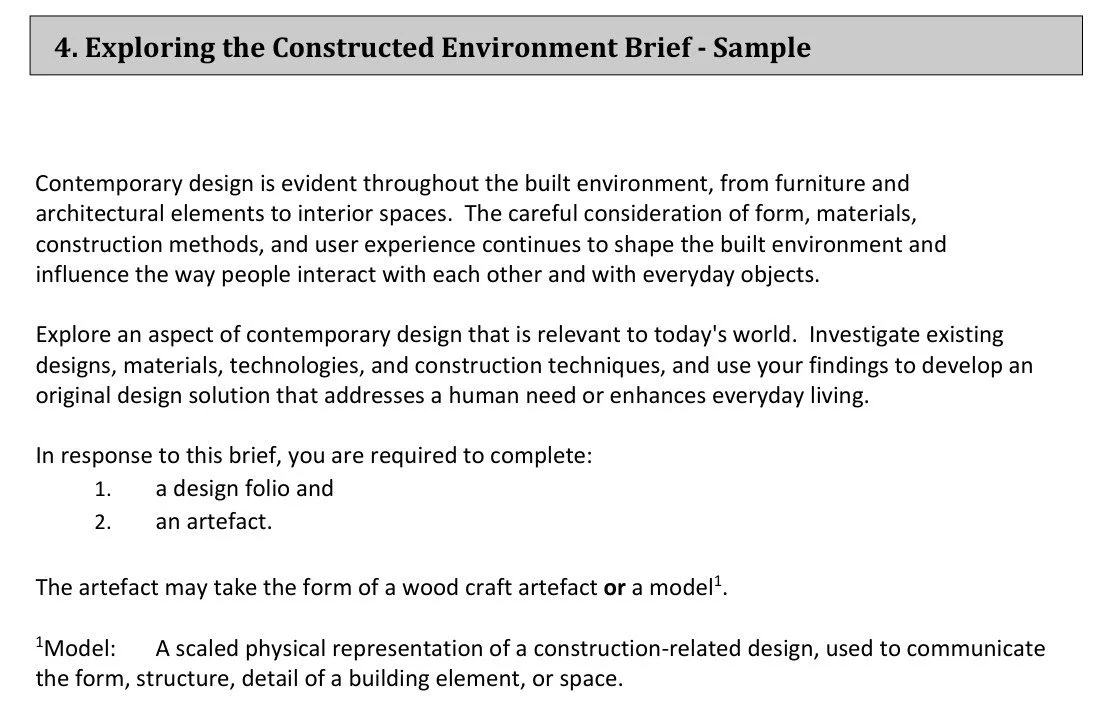
The brief is two short paragraphs. The first sets the scene. The second sets the task. This is the SEC's sample brief.
You choose your own design focus
Inside the theme, you decide what to design, who it is for and what need it meets. No one hands you a project to make.
Choose a focus that suits your interests, your skills, the time you have and the materials you would like to work with.
The brief is your chance to show the whole subject. Ask these four questions at every stage of your project.
Who is it for? Where does it go? Is it sustainable and easy for everyone to use?
What is it made of? How is it made, and why that way?
How is it built? How does it deal with load, heat and moisture?
Does it use or save energy, water or light? Is anything controlled?
2Make a wood craft artefact or a model
The brief allows two kinds of artefact. Many students do not know about the second one. Both are marked the same way.
A wood craft artefact
A piece of furniture, a fitting or a product, made to a high standard of craft. This is the route most students take.
The craft pieces you make in practical classes in 5th year build the skills you need for it.
A model
The SEC defines a model as a scaled physical version of a construction design. It shows the form, the structure, the detail of a building element, or a space.
- A wall-to-floor junction at 1:5, showing the insulation and the airtight layer.
- A room laid out for a wheelchair user, to scale.
- A rainwater-harvesting detail.
- A whole building to scale, showing its form and how it sits on its site.
3Your design journey: five stages
The SEC calls this "My Design Journey". In the rows below, the bars show how your 35 hours are shared out. The marks show what each stage is worth.
4Where the 180 marks go
The blocks are drawn to scale by marks.
Design folio · 80 marks
- Explore and investigate 25
- Development of a design solution 25
- Planning the manufacture 15
- Evaluation and reflection 10
- Overall coherence and presentation 5
Artefact · 100 marks
- Artefact satisfies the brief 10
- Creativity 10
- Craft skills and techniques 60 — marking out, processing, assembly, and the range and depth of your skills
- Finishing and presentation 20
The same 180 marks, sorted by the kind of work.
- The whole folio (80), plus the artefact marks for satisfying the brief (10) and creativity (10).
- Craft skills and techniques (60), plus finishing and presentation (20).
5What you hand in
The design folio
- No more than 16 single-sided A4 pages. An A3 page counts as two. The cover and the reference pages do not count.
- Your own original sketches. Freehand work is evidence of your thinking.
- A printed photograph of your finished artefact.
- Every source referenced, in the text and in a reference list.
- If you use AI (artificial intelligence), you say so: the tool, the date and how you used it.
The artefact
- A wood craft artefact or a model.
- Made in school, with your teacher supervising.
- It stays in school until results and any appeals are over. It must never leave the building.
- Any part cut on a laser cutter or made on a 3D printer needs its own CAD (computer-aided design) drawing in your folio, marked with your exam number. That drawing shows the part is your own work.
Give your pages to the sections that carry the marks. The page ranges are the SEC's suggestions.
| Folio section | Marks | Pages |
|---|---|---|
| Explore and investigate — your own research counts most: visiting, sketching, measuring, photographing, testing | 25 | 2–8 |
| Development of a design solution | 25 | 2–4 |
| Planning the manufacture | 15 | 2–4 |
| Evaluation and reflection | 10 | 1–2 |
| Overall coherence and presentation | 5 | — |
| Total | 80 | 16 at most |
6Your project across 6th year
This is one typical plan. Your teacher decides how your classes are used, and will give you your school's dates.
Get ready in 5th year. The habits that earn project marks start long before the brief.
Build your craft skill
Every craft piece you make in practical classes is practice for the 60 craft-skill marks.Sketch every week
Freehand sketches are how a folio shows your thinking. Keep every sheet in one folder.Look, measure, record
When you study a building in class, notice how it was designed and built. That is the research the project asks for.7Your work, your words
The project must be your own work. Your teacher confirms that by seeing it grow, week by week.
Your teacher can
- Talk through the theme with the class when the brief arrives.
- Help you test whether a focus suits your skills, the time and the materials you want to use.
- Explain what the marks look for at each stage, before you start.
- Ask you questions that push your thinking.
- Give you general feedback.
- Agree your making plan with you, and supervise all of the making.
Your teacher cannot
- Choose your design focus for you.
- Correct or rewrite your drafts.
- Give you a folio template or a worked example, not even a blank page layout.
- Cut, shape or prepare any part that you hand in as your own.
- Step in while you make, except to stop something unsafe.
8Practise with a brief
Five practice briefs, written in the same shape as the SEC's sample. They are for practice. They are not predictions of the real brief. For each one, try defining your own design focus before you look at the examples.
Comfort and energy in the home
Much of the energy used in Irish homes is lost through walls, floors, roofs, windows and doors. Careful design and construction can keep a home warm, dry and healthy while using less energy.
Explore an aspect of the home where comfort and energy use meet. Investigate existing products, materials and construction details, and use your findings to develop an original design solution that improves comfort or reduces energy use.
Living well, for longer
People are living longer, and many want to remain in their own homes. Thoughtful design can make everyday tasks easier and safer for people of all ages and abilities.
Explore an aspect of the home or its surroundings that affects independent living. Investigate existing designs, standards and technologies, and use your findings to develop an original design solution that supports people to live well at home.
Building with what we have
Construction uses large amounts of materials, and much of what is removed from buildings ends up as waste. Reusing materials and choosing them well can reduce the impact of building on the environment.
Explore how materials are sourced, used and reused in the built environment. Investigate traditional and contemporary practices, and use your findings to develop an original design solution that makes better use of materials.
Nature and the built environment
Buildings and the spaces around them can support wildlife and bring people closer to nature. Design that welcomes nature can benefit health, wellbeing and biodiversity.
Explore how the built environment can make room for nature. Investigate existing designs, materials and construction techniques, and use your findings to develop an original design solution that brings people and nature closer together.
Water and the home
Water shapes how buildings are designed, from keeping rain out to using it wisely. Changing weather patterns bring heavier rainfall and new pressures on homes and their surroundings.
Explore how buildings and their surroundings manage water. Investigate existing systems, materials and construction techniques, and use your findings to develop an original design solution that manages water better.
Sources: SEC (State Examinations Commission), Sample Brief: Exploring the Constructed Environment (2028L029C2ES); brief page reproduced from the SEC. NCCA (National Council for Curriculum and Assessment) (2025), Guidelines to support the Additional Assessment Components in Leaving Certificate Construction Technology. Practice briefs: constructiontechnology.ie. © constructiontechnology.ie 2026